

Trends and Automation in the Automotive Industry 2026: A Guide to Optimizing Production Lines and Manufacturing
⚙️ 2026 Operational Key: Is your plant losing profitability due to downtime? Discover how automated cells and artificial vision optimize manufacturing.
In a highly competitive environment, the automotive industry demands precision and speed. The integration of automated cells enables manufacturers to optimize cycle times, minimize unplanned downtime, and ensure quality standards compliance under regulations such as ISO/TS 16949.
1. Industry Overview in the Region
OPERATIONAL CHALLENGES AND DEPLOYMENT IN TIER 1 AND TIER 2 PLANTSThe accelerated growth of assembly plants requires high operational flexibility and zero margin for error. The adoption of robotic infrastructure and programmable logic control (PLC) enables plant engineers to respond quickly to changes in production volumes. Key challenges include:
- Zero Defects and Traceability: Validation through unique codes assigned to each released component to ensure complete tracking.
- Cycle Time Reduction: Continuous optimization without compromising safety or assembly precision.
- Automated Inspection: Proactive prevention of shipments that do not meet dimensional or technical specifications.
2. Key Automation Solutions for Assembly Lines
HIGH-PRECISION TECHNOLOGIES AND REAL-TIME CONTROLTo achieve intelligent and interconnected manufacturing, it is essential to implement comprehensive automation solutions that cover everything from preliminary mechanical design to process logic control:
Robotic Cells (Pick & Place)
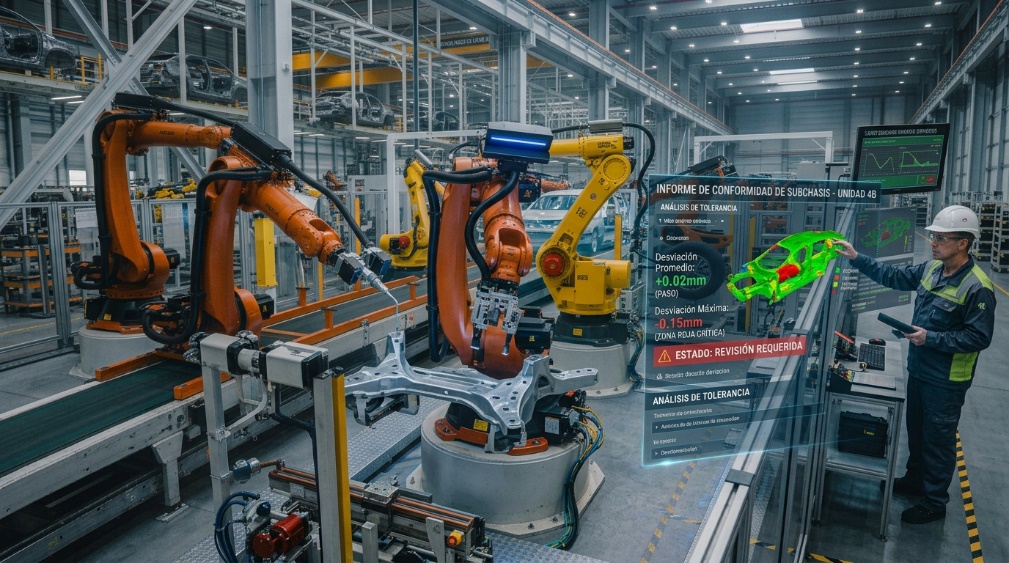
The integration of articulated robotic arms automates cutting, trimming, sorting, and the continuous flow of materials, from primary plastic injection molding processes or CNC machining operations to their final placement in containers.
Artificial Vision Poka-Yoke Systems
Implementation of smart cameras and photoelectric sensors to validate threads, detect surface defects in real time, and automatically separate approved parts from rejected parts (OK vs. Scrap).
Indexed Tables and Dimensional Verification
Rotary systems with 8 synchronized stations that enable marking, laser measurement, and precision assembly within a single compact workstation through PLC control and HMI visual monitoring.
3. Plant Impact Matrix
TECHNICAL BENEFITS AND COMPARATIVE PERFORMANCEEvaluation of the main technological solutions against quality and industrial hygiene requirements in continuous production lines:
| IMPACT AREA | TECHNICAL SOLUTION | PLANT IMPACT |
|---|---|---|
| Cycle Time | High-speed robotic cells | Optimization and acceleration of the continuous production cycle. |
| Quality Control | Machine vision and laser validation | Zero errors in dimensional verification. |
| Traceability | Point-to-point digital marking | Compliance with ISO/TS 16949 requirements. |
| Safety | Guarding systems with electromechanical interlocks | Safe operation and operator protection. |
4. Turnkey Engineering and Integration
IMPLEMENTATION METHODOLOGY AND PROJECT PHASESTo ensure that systems operate according to the most demanding industrial standards, the work methodology integrates every stage of technological development:
- 1. 3D Mechanical and Electrical Design: Detailed CAD modeling for fixtures, tooling, and end-effectors.
- 2. Programming and Logic Control: Advanced configuration of PLCs, industrial networks, and HMI interfaces for intuitive diagnostics.
- 3. FAT Testing and On-Site Installation: Factory Acceptance Testing (FAT), equipment leveling and commissioning at the plant, along with technical support during the initial startup phase.
Would you like to learn more about our automotive solutions?
CLICK HER-E